
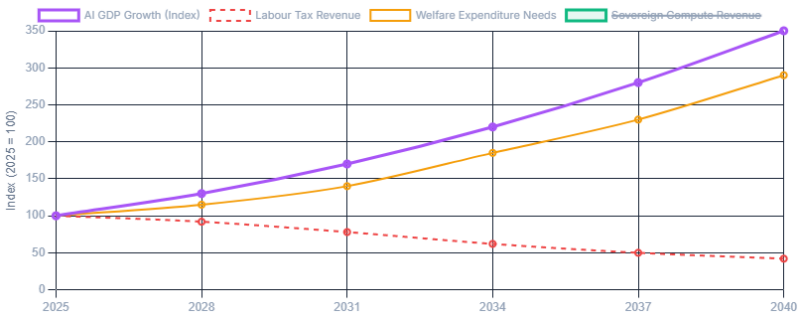
We are rapidly approaching a macroeconomic paradox. As artificial intelligence and robotics integrate into the economy, national productivity and gross domestic product (GDP) will inevitably rise. Yet, under our current system, the state is heading towards bankruptcy.
The flaw lies in the UK’s taxation framework. The modern welfare state is built almost entirely on taxing human labour through Income Tax and National Insurance. But as AI displaces human workers, or severely suppresses wage growth, this primary revenue stream begins to dry up. Simultaneously, the demand for welfare spending—or eventually, a Universal Basic Income—will skyrocket as automation increases unemployment.
It is an economic doom loop: the technology makes the country wealthier, but the state becomes poorer. To fix this, we must fundamentally shift taxation away from labour and onto capital and compute. The solution is not merely regulating big tech; it is building a State-Owned Enterprise (SOE) to control the infrastructure itself.
The Paradigm Shift: Sovereign Compute
Currently, private tech monopolies build massive datacentres, absorb the capital expenditure (CapEx), and reap 100% of the profits generated by leasing that compute power.
We need to treat AI compute and data processing not as a private service, but as a foundational public utility—like the electrical grid or the highway system. If the UK government builds and owns a state-of-the-art datacentre and robotics infrastructure, it acts as a monopoly or major competitor in the compute market. Because the state owns the “means of production” for AI, the revenue generated by leasing that compute flows directly back to the Treasury, replacing the lost revenue from traditional Income Tax.
Key Insight: If data and compute are the “new oil” of the 21st century, the UK should not just buy shares in the oil companies; we must own the rigs.
The ‘AI Pension’ Mechanism
How does a government burdened by debt fund the staggering initial CapEx required to rival private tech giants? By taking a lesson from an incredibly successful existing policy: the Automatic Enrolment Workplace Pension.
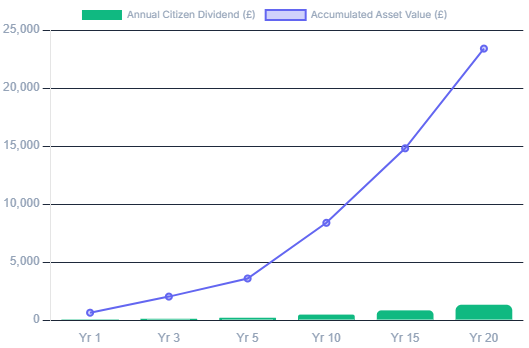
If the government mandates a 1-2% contribution from citizens, it must not be framed as a traditional tax that disappears into a bureaucratic black hole. Instead, it functions as a direct equity investment into the UK’s sovereign AI infrastructure.
Citizens are effectively buying shares in a national asset. When those state-owned datacentres generate profit—by leasing compute to domestic startups or automating public services—the yield is paid back to the public as a citizen dividend. It transforms taxpayers from passive subjects fearful of automation into active shareholders of the AI age.
Lessons from the Nordics and Alaska
This is not a radical, untested economic theory. We only need to look at how other nations have managed their natural monopolies.
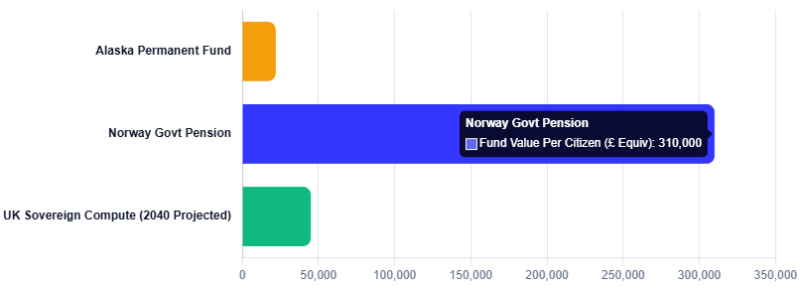
- The Alaska Permanent Fund: When oil began flowing from Alaska’s North Slope in the 1970s, the state required a portion of the wealth to be invested. Today, it pays an annual Permanent Fund Dividend (PFD) to every eligible resident, averaging around $1,600 per person.
- Norway’s Sovereign Wealth Fund: Norway channelled its North Sea oil revenues into what is now a $1.8 trillion fund, securing the long-term welfare of its citizens and actively using AI to manage its global investments.
The UK largely missed the boat on leveraging its physical oil wealth for a sovereign fund. However, we have a second chance with digital infrastructure. By owning the datacentres, the UK creates its own sovereign wealth engine from scratch.
Checkmate on Corporate Tax Avoidance
Perhaps the most powerful argument for a state-owned compute utility is its ability to instantly solve the crisis of multinational tax avoidance.
Currently, tech giants routinely exploit the UK tax framework by routing profits through complex corporate structures and registering their headquarters in low-tax jurisdictions like Ireland or Luxembourg. In 2021 alone, this cost the UK an estimated £2 billion in lost Corporation Tax. The government struggles to combat this because accountants can easily offshore a spreadsheet.
You cannot, however, offshore physical latency or data sovereignty.
If the UK government mandates that domestic public data (such as NHS records or critical government services) must be processed natively on sovereign servers, the power dynamic flips entirely. If foreign tech giants want to operate high-performance AI services within the UK market, they must rent the physical compute power from the UK’s state-owned datacentres.
We no longer have to chase these corporations for tax. Instead, we charge them a premium, unavoidable “utility fee” at the point of access. We turn tax avoidance into an infrastructure leasing cost. If they want to operate in the UK economy, they pay the state directly to use the servers.
Conclusion
The AI productivity trap is only a trap if we allow private monopolies to capture all the generated wealth. By treating compute as a sovereign utility, funding it through an equity-style public contribution, and forcing tech giants to pay for access, the UK can rewire its economy for the 21st century.
Automation does not have to mean the end of the welfare state; managed correctly, it can fund the most prosperous era in British history.
