
The United Kingdom is a global service superpower. Unlike nations built on heavy manufacturing or industrial exports, the UK economy runs on human brains, office-based expertise, and analytical skills. Today, the service sector accounts for roughly 80% of the UK’s total economic output and employment.
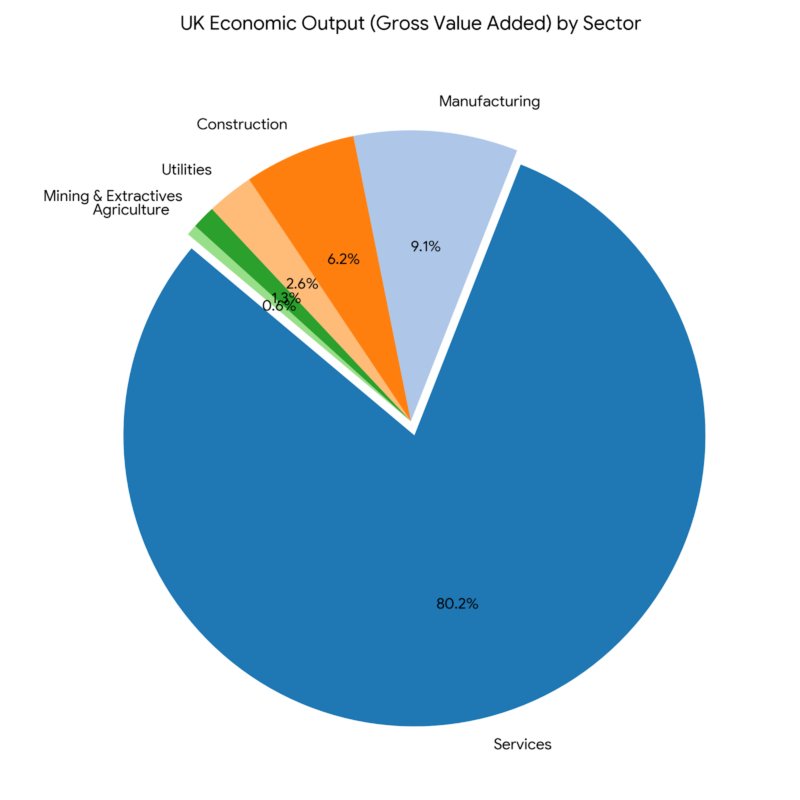
While this mix has driven decades of prosperity, it leaves the UK uniquely vulnerable to advanced automation. Because the vast majority of British jobs exist in the digital realm of text, code, numbers, and strategy, the UK workforce is directly in the crosshairs of accelerating artificial intelligence.
If machines take over the roles that define our professional class, it will trigger an unprecedented societal crisis: widespread structural unemployment, a broken career ladder for the next generation, and a state machine that can no longer afford to fund itself.
The Leap to AGI
To understand why this disruption feels so imminent, we have to look at the leap from the software we use today to what is arriving next.
The platforms currently integrated into our workplaces are Artificial Narrow Intelligence (ANI). They are highly sophisticated tools, but they are limited to specific, isolated tasks—like drafting a basic email or analysing a single spreadsheet. They still require constant human management.
Within the next few years, however, the tech sector anticipates the arrival of Artificial General Intelligence (AGI)—systems possessing human-level cognitive flexibility across nearly all domains. Instead of just answering prompts, AGI will be capable of independent reasoning, solving novel problems, and managing complex projects completely autonomously.
The architects of this technology are incredibly candid about its disruptive potential. OpenAI formally defines AGI as:
“…highly autonomous systems that outperform humans at most economically valuable work.”
Silicon Valley leaders expect this shift to occur incredibly fast. Elon Musk recently forecast an accelerated timeline, stating, “I think we’ll hit AGI next year in 2026,” adding his expectation that AI will comfortably exceed the intelligence of all humans combined by 2030. When a system reaches that threshold, it stops acting as an assistant to a service worker and becomes fully capable of replacing them.
White-Collar Unemployment and Broken Ladders
Moving from human labour to AGI will hit the UK labour market with immense friction, creating deep waves of structural unemployment. Because white-collar firms can utilise software to instantly scale their output, the demand for human personnel faces a sharp correction.
The immediate damage is already appearing at the entry level. Tasks traditionally handed to graduates and junior staff—such as basic legal research, document drafting, data processing, and initial code generation—are the easiest for AI to automate.
This creates three critical wider impacts on society:
- The Disappearing Corporate Ladder: As companies automate junior roles to save on costs, they inadvertently destroy the training grounds for the next generation of managers, accountants, and executives.
- A Prolonged Hiring Downturn: Recruitment across professional services faces massive freezes. Businesses are increasingly hesitant to take on human overhead when software capabilities are expanding month by month.
- Mass Reskilling Friction: A redundant 40-year-old administrative manager or financial analyst cannot instantly retrain as an AI engineer or a physical infrastructure technician overnight. This mismatch leaves workers stranded in long-term unemployment.
Stable GDP vs. Collapsing Taxes
If AGI systematically replaces human professionals across the UK’s 80% service economy, it creates a unique macroeconomic paradox: the UK’s Gross Domestic Product (GDP) could remain perfectly stable—or even grow—while government tax revenues collapse.
GDP measures the total value of all goods and services produced by a nation. If a financial consultancy or a corporate legal department replaces 500 human employees with an AGI system, the economic output of that firm does not disappear. Because algorithms do not sleep, take sick leave, or make human errors, corporate production will likely increase. On paper, the UK economy will look highly successful and wealthy.
The crisis lies entirely in how that wealth is taxed. When work shifts from human payrolls to software infrastructure, the mechanism for funding public services like the NHS breaks down:
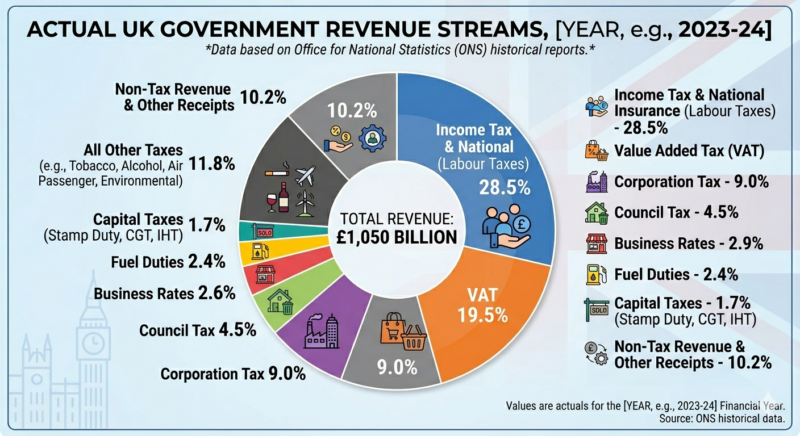
- The Income Tax Cliff: Income tax is the single largest source of government revenue, accounting for roughly 28% of all state income (rising to over 44% when combined with National Insurance Contributions). When service workers are displaced by AGI, this massive revenue stream shrinks dramatically.
- The Consumption Squeeze: Because unemployed individuals drastically reduce their spending, Value Added Tax (VAT) collections—which bring in another 16% of state revenue—will face a parallel decline.
The Wealth Distribution Crisis: The Gary Stevenson Factor
This breakdown highlights the ultimate danger of automated growth: a total collapse in wealth distribution. When an economy replaces human labour with AGI, the financial rewards of that production no longer circulate through society via monthly paychecks. Instead, the wealth scales straight to the top, funneling directly into a tiny group of tech founders and corporate capital owners.
This dynamic aligns perfectly with the warnings flagged by British economist and inequality campaigner Gary Stevenson (GarysEconomics). Stevenson’s central thesis is that an economy’s ultimate undoing isn’t a lack of production, but the hyper-concentration of wealth.
When wealth is distributed through wages, ordinary people spend their income back into the high street, keeping the economy alive. But when AGI concentrates that wealth into the hands of a few corporate asset owners, the money stalls. The ultra-rich simply cannot buy enough everyday goods or services to replace the collective spending power of millions of displaced workers. Because an algorithm pays zero income tax and has no purchasing power, the circulating cycle of demand evaporates.
While corporate profits will skyrocket, current tax frameworks mean Corporation Tax only brings in about 10% of the UK budget. Furthermore, corporate digital profits are notoriously easy for multinational firms to shift across borders.
Conclusion
The challenge for the UK over the next 15 years is not that value creation will disappear, but that the wealth generated by AGI will be entirely cut off from the people who used to do the work. Widespread job losses in the service sector will stress the welfare state just as tax revenues hit a wall. To prevent an unprecedented fiscal and social crisis, future governments cannot simply rely on traditional safety nets. They will have to radically restructure the tax code—moving away from a heavy reliance on taxing human labour and toward capturing the immense productivity gains concentrated at the very top of the machine.
